
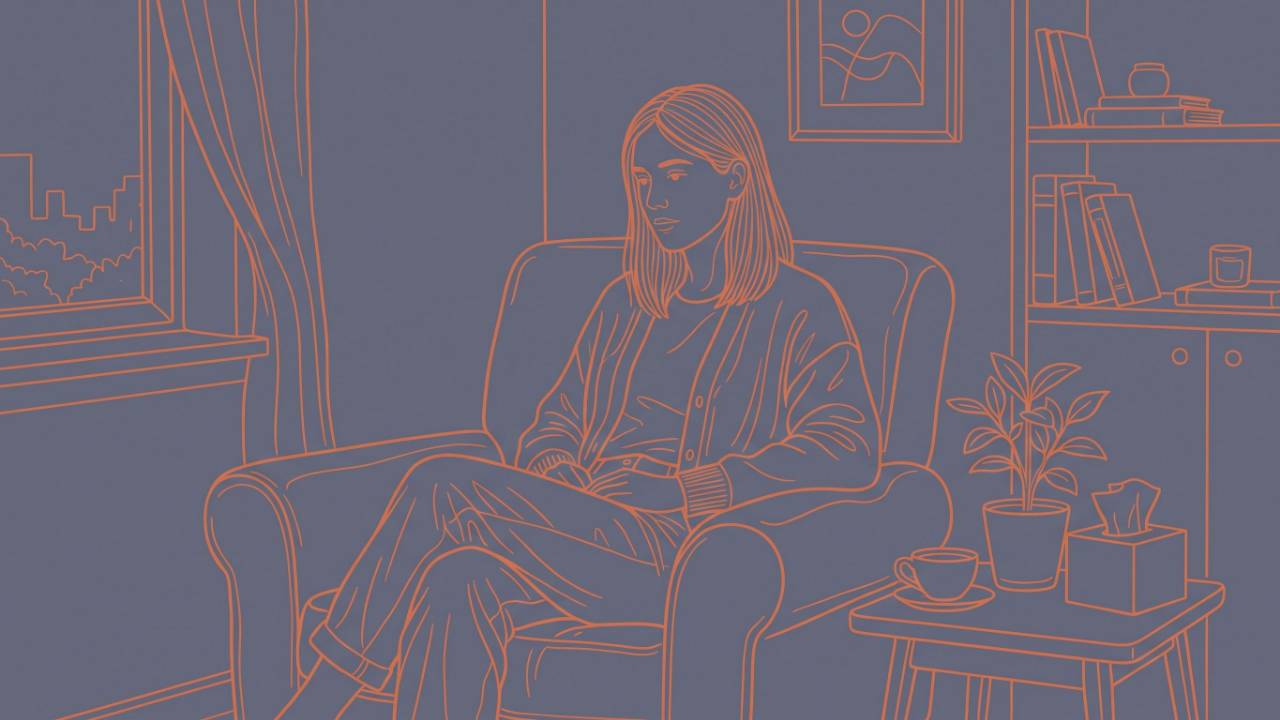
Sometimes it’s easier to talk from your own space.
You might feel more like yourself in familiar surroundings.
Your own chair, a warm drink or a pet nearby can help your body settle.
Starting something new can be less daunting from home.
Maybe you feel:
- more open with a little distance
- pressed for time
- uncomfortable accessing services nearby
- uneasy in waiting rooms
A calm nervous system gives you more space to think, feel and speak.
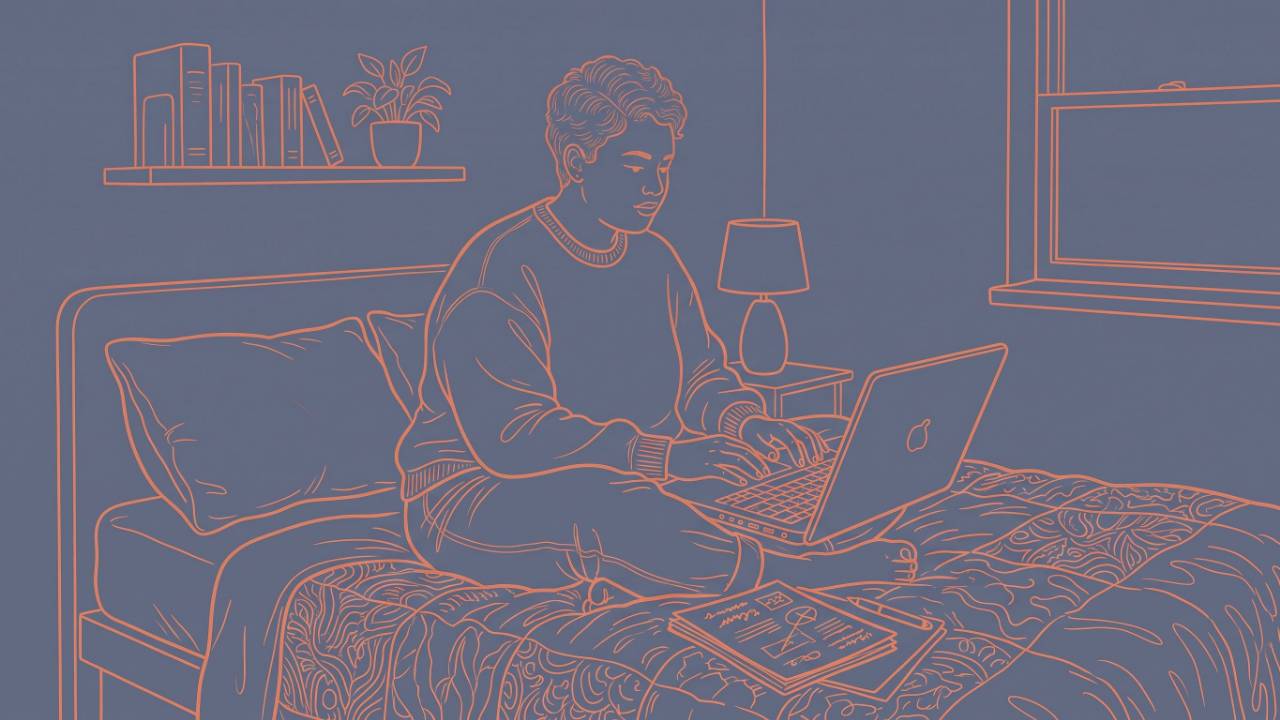
Online therapy lets you choose where therapy happens.
What is Online Therapy?
Online therapy is therapy with a registered therapist by secure video or phone.
It starts from the idea that healing happens through the relationship, wherever it takes place.
It works through regular live sessions, with your therapist’s full attention on you.
You might join from your home, your parked car, a friend’s house or a quiet office on your lunch break.
Virtual therapy is especially helpful for people with anxiety, depression and sleep concerns.
Research shows it’s as effective as in-person therapy.
Online therapists adapt their care so you can feel connected through a screen.
What is an Online Therapist?
An online therapist is a registered therapist who offers sessions by video or phone.
Online is a way of meeting rather than a separate approach, so there’s no required certification.
Some therapists take extra training in online therapy, like workshops or continuing education.
Some offer virtual sessions only, and others mix virtual and in-person sessions.
Online, you can choose from therapists across the province, not only those nearby.
Look for a therapist registered in Alberta, who knows the services and supports close to you.
What matters most is that the therapist is a good fit for you.
The Process of Online Therapy
Online therapy is relational and flexible, shaped by the approach you and your therapist choose.
You begin by planning for privacy and dropped calls, then talk about what brings you in.
As trust builds, you might find the distance makes it easier to say the hard things.
Between sessions, you might try what you’re learning in the same places you’ll use it.
There’s no set length, and the goal is whatever brought you to therapy.
Trauma-sensitive online therapy builds safety first and makes room for what your body needs.
The origin story starts with a telephone.
In 1935, a young priest in England led his first funeral, for a 14-year-old girl who had died by suicide.
She had been frightened by changes in her body and had no one to ask. The priest, Chad Varah, vowed to help people who had nowhere to turn.
In 1953, Varah became rector of St Stephen Walbrook, a church in London. That November, he opened a phone line for people in despair. Callers could talk to someone without showing up in person. A month later, a newspaper story called the line the Samaritans. It brought more calls than he could answer alone, and volunteers joined him.
Continue reading
Across the Atlantic, the Nebraska Psychiatric Institute in Omaha was testing therapy by television. By 1961, psychiatrist Cecil Wittson and his colleagues were leading patient groups over closed-circuit TV.
Audiovisual specialist Reba Benschoter led the next step. On December 2, 1964, a two-way TV link connected the institute to Norfolk State Hospital, 112 miles away. Staff and patients there could now meet with psychiatrists in Omaha without the long drive.
As home internet spread, some therapists began offering sessions by video. In November 1997, the American Psychological Association said therapy by phone or internet was allowed, with care for privacy. Studies of how well it worked were encouraging. In 2006, the Canadian Psychological Association set out ethical guidelines for therapy through electronic media.
Researchers at the US Department of Veterans Affairs wanted to reach veterans with PTSD who lived far from care. In 2014, veterans on four Hawaiian islands went to a local clinic and met with a trauma therapist by video. It worked as well as meeting in person. Two years later, a second study brought video sessions into veterans’ homes, with the same results.
Then, in March 2020, the COVID-19 pandemic reached Alberta. Within weeks, many therapists moved their sessions to video and phone. Many clients and therapists found they liked it, and online therapy became an everyday part of care. Since then, psychology associations in Canada and the US have updated their guidelines, and research keeps showing it works.
But the sudden shift to home left little time to plan for trauma.
For some people, home is where the harm happens. Therapy can feel unsafe in that place or with that person nearby.
Home isn’t always private either. Being overheard by family or roommates can make it hard to speak freely.
And not every platform was built for privacy. In 2023, the US Federal Trade Commission ordered BetterHelp to pay $7.8 million. It had shared clients’ health information with advertisers like Facebook.
Hard memories can come up, and when the session ends, you’re still in the same room, on your own. Distance can also make a crisis harder to respond to when a therapist doesn’t know exactly where you are.
Trauma-sensitive online therapy works inside those gaps. It checks in about safety at home and other places you could join from. It plans together for privacy, with headphones, white noise or a code word. It uses secure platforms and explains how your information is stored. It leaves time to settle before the call ends. And it makes a safety plan that includes where you are and who to call.
Trauma-sensitive therapy starts with a connection you can trust.
Trauma-Sensitive Online Therapy
What if you need to know you can leave?
After trauma, your body can relax more easily when it knows there’s a way out.
In trauma-sensitive online therapy, you can pause, step away or end a call early, and come back when you’re ready.
5 phrases you might hear in Trauma-Sensitive Online Therapy:
- Thanks for letting me know where you are today.
- What would help you feel more comfortable?
- Take your time, there’s no rush.
- I notice you’re looking toward your door.
- Let’s take a minute to ground before we end.
Trauma-sensitive online therapy invites you to connect at your pace.
Principles of Trauma-Sensitive Online Therapy
Safe places
Where you are shapes how safe you feel. You choose where you join from and what shows on screen.
Real relationship
Trust can grow across distance. You can build a close connection with a therapist one day at a time.
Camera optional
Being watched can feel unsafe. You can start with phone sessions or with your camera turned off.
Home comforts
Your own space can help you feel safer. Pillows, blankets, pets and other comforts are welcome.

Trauma-Sensitive Care
Online therapy was built to reach people where they are.
After trauma, it can be hard to settle no matter where you are.
Feeling shaky, numb or far away can be ways your body protects you.
Trauma-sensitive care is a way of practicing online therapy that honors your reactions as protection.
It adapts to what you need and what works for you.
A trauma-sensitive online therapist stays connected, checks in and gives you more time when you need it.
Trauma-sensitive care helps you come back to yourself.
Questions About Online Therapy
What do I need for online therapy?
What if I don't have a private space?
Is online therapy private and secure?
Can couples and families meet online?
What happens if I'm in crisis during a session?
Will my insurance cover online therapy?
Where would you like to go next?


Related Topics in This Library

Free mental health education for trauma-sensitive care in every room and relationship.
Mailing Address:
11500 29 St SE #105
Calgary, AB T2Z 3W9